
Every serious camera bag in 1985 had a small side pocket, and in that pocket lived a stack of flat round cases.
Inside each one was a disc of optical glass with a metal thread around its rim. One was pale amber. One was deep blue. One looked faintly milky, like breath on a window. One had impossibly fine lines etched across its surface. And one — the strange one — was dark at the top and clear at the bottom, as if someone had dipped half of it in smoke. You chose one, screwed it onto the front of the lens, and the world changed before the light ever touched your film.
That was the entire trick, and it is worth saying plainly: a lens filter worked ahead of everything else. Light passed through the filter, then the lens, then landed on the film. Your film was a commitment — 24 or 36 frames, no changing your mind — but the filter could change from one shot to the next. It was the only per-frame creative decision the analog era gave you, and photographers used it constantly.
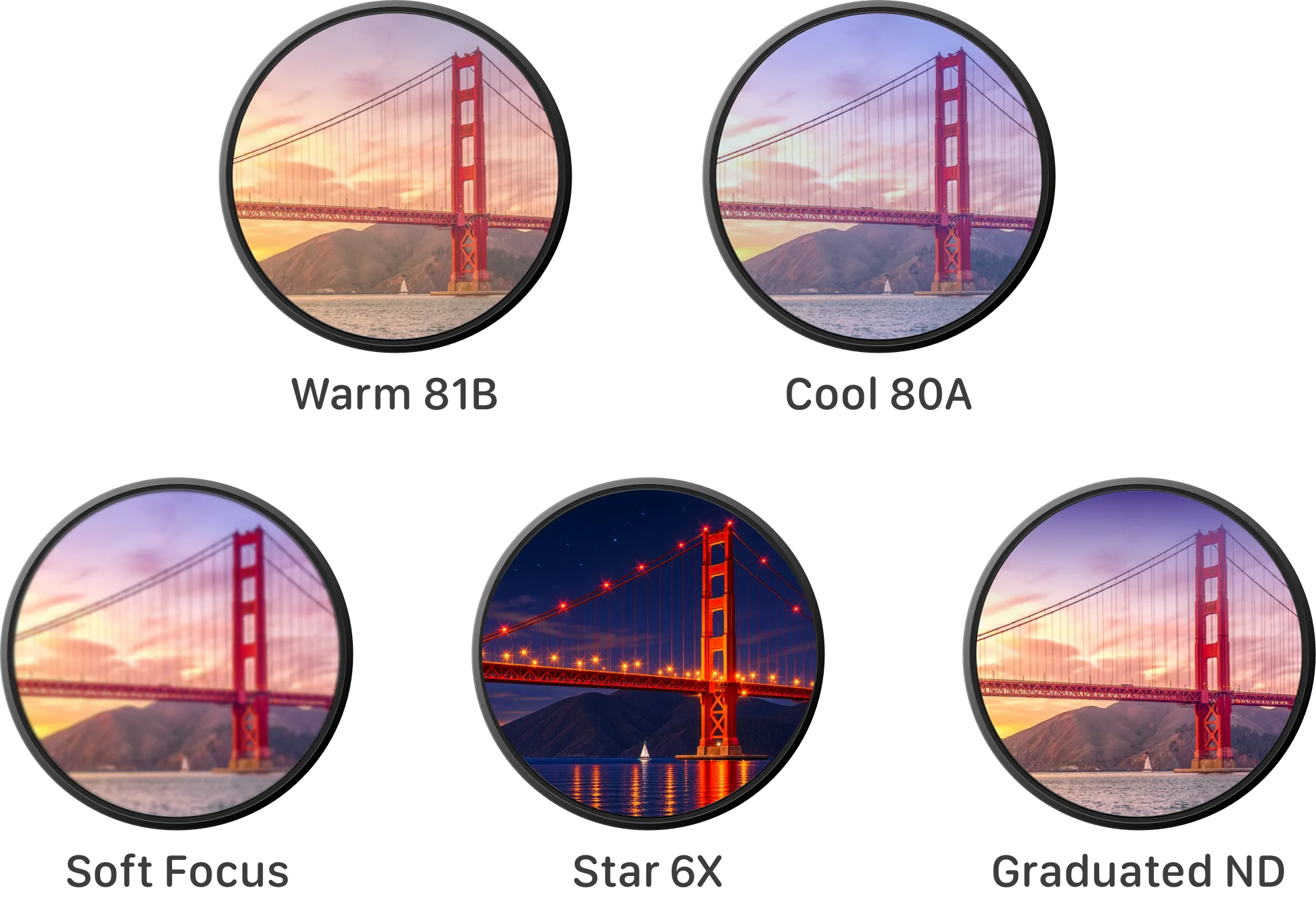
DIGIX AMR1 now puts that stack of glass back in your bag. Five lens filters join the eight film simulations: Warm 81B, Cool 80A, Soft Focus, Star 6X, and Graduated ND — a six-position selector, counting the most honest setting of all, No Filter.
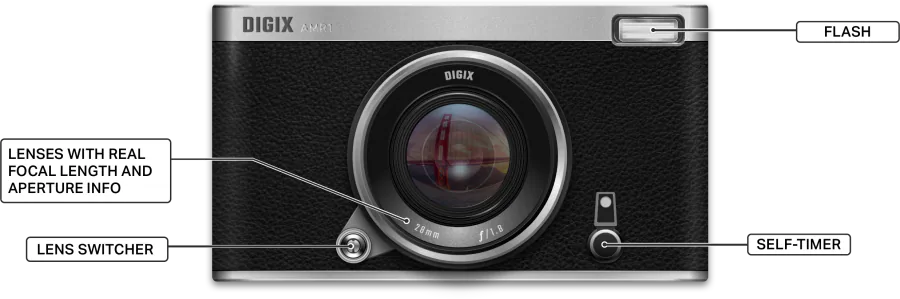
And they behave exactly the way the physical ones did. The filter shapes the incoming light first; then whichever film you loaded develops that filtered scene in its own character. Scene, then filter, then film, then photograph — the same order as 1985. The two systems are completely independent, which means any filter works with any of the eight film simulations: forty-eight combinations from two simple dials.
Like the films, these five are not arbitrary effects with invented names. Each descends from a real piece of glass that solved a real problem. This article is the story of that glass, and a practical guide to knowing which filter to thread on.
Why Filters Existed at All
Film had one enormous limitation that digital shooters never think about: it could not adapt. There was no white balance setting. A daylight color film was built for noon sunlight at roughly 5500K, and it rendered every other light faithfully wrong — blue in the shade, orange under a living room lamp.¹ If the light didn't match the film, you had exactly two options: live with the cast, or fix it with glass.
So an industry of correction grew up, and it spoke a shared language of numbers. Frederick Wratten founded one of the earliest photographic supply houses, Wratten & Wainwright, in London in 1878; when Kodak acquired the firm in 1912, the Wratten numbering system came with it and became the standard the whole industry used.² That is why two of our filters carry such strange, bureaucratic names. "81B" and "80A" are not product branding — they are Wratten numbers, the same designations printed on the rims of the real filters photographers argued about in camera shops.
The other three filters in the pouch were never about correction. Soft focus, star, and graduated glass existed to do openly what correction filters did quietly: change how the photograph would feel. Together, the five cover the whole span of what screw-on glass could do — from a fix so subtle nobody notices to an effect so bold it becomes the picture.
The Five Filters
Warm 81B · Gentle Warming
The real thing. The Wratten 81 series were the "warming filters" — pale amber discs, sold in an alphabet of strengths from 81A upward, that nudged cool light back toward neutral.³ Open shade, overcast skies, high altitude, electronic flash: all of them skew blue on daylight film, and all of them were the 81 series' daily work. The 81B sat in the sweet spot of the range — enough warmth to feel, not enough to see — and it cost only about a third of a stop of light, so photographers could leave it on for hours.³
Portrait and wedding photographers in particular treated an 81B as a standing prescription. Skin tones that film rendered slightly gray or cold came back to life through it, which is why so many professionals of the era simply never took it off.
When to thread it on. Overcast days, open shade, snow, and any portrait where skin looks a touch cold. The 81B is the filter you use when nothing is exactly wrong but the picture feels unfriendly. If someone looking at the photo can tell a filter was used, this one has failed — its whole job is to be invisible.
Cool 80A · Blue Conversion
The real thing. The 80A was the strongest medicine in the pouch: a deep blue conversion filter built for one specific emergency. Load daylight film, walk indoors, and shoot under ordinary tungsten bulbs at 3200K, and everything comes back a heavy orange. The 80A converts that tungsten light all the way up to the 5500K balance the film expects — a correction so aggressive it swallows two full stops of light along the way.³
That two-stop price is why the 80A lived in the bag rather than on the lens. You accepted it when you had to — a roll of daylight Kodachrome and an indoor assignment — and photographers soon discovered its second life: on already-neutral light, an 80A plunges a scene into a deliberate, moody blue that reads as dusk, winter, or melancholy.
When to thread it on. Warm interior light you want neutralized — lamps, candles at a distance, tungsten-lit rooms. Or use it the expressive way: cool an ordinary scene into blue hour, give a street a cold cinematic cast, or strip the warmth out of a frame that feels too cozy for its subject.
Soft Focus · Optical Diffusion
The real thing. Soft focus is not the same as out of focus, and the distinction is the entire craft. A diffusion filter keeps a sharp image underneath and scatters a controlled fraction of the light over it, so highlights bloom into a gentle halo while edges and eyes stay defined.⁴ The tradition runs from the deliberately dreamy portrait lenses of early Hollywood through Zeiss's famous Softar — a filter covered in tiny lenslets that diffused light without destroying detail — and on to the airy, luminous style David Hamilton made recognizable worldwide.⁴
By the 1980s, diffusion was simply how professional portraiture looked. Wedding albums, studio portraits, album covers, glamour photography — a soft filter flattered skin, romanticized backlight, and turned every point of light in the background into a glowing coin.
When to thread it on. Portraits, first and always — it softens skin texture while the eyes stay sharp. Then anything sentimental: backlit hair, candlelit tables, flowers, lace, a window with afternoon sun. Soft Focus tells the viewer this is a memory, not a document. Do not use it on subjects that live on texture — brick, machinery, food — where the bloom reads as haze.
Star 6X · Diffraction Special Effect
The real thing. Etch a grid of impossibly fine lines into a piece of clear glass, and physics does something delightful: every bright, concentrated point of light that passes through diffracts along those lines and stretches into rays.³ Each direction of etched lines produces one pair of opposing rays, so three sets of lines yield a six-pointed star — the classic "6X" of the cross-screen family.⁵ The effect only springs from genuinely bright, compact highlights; the rest of the image passes through almost untouched.
The 1970s and 80s could not get enough of it. Television variety shows put star filters on studio cameras until every sequin sparkled; concert photographers turned stage rigs into constellations; and every night-time city postcard of the era, with its streetlamps radiating perfect six-pointed stars, owes its glitter to this exact piece of glass.
When to thread it on. Night streets, holiday lights, candle flames, chrome and glass catching the sun, light dancing on water. The Star 6X is the least subtle filter in the set and it knows it — the star is not an accent, it is the subject. Use it when you want the photograph to sparkle on purpose, and take it off before it becomes a habit.
Graduated ND · Exposure Balancing
The real thing. The graduated neutral density filter — the one dipped in smoke — solved the oldest problem in landscape photography: the sky is dramatically brighter than the land, and film could not hold both. Expose for the foreground and the sky washes out to blank white; expose for the sky and the land sinks to black. A GND is dark at the top, clear at the bottom, with a soft transition between, so it dims the sky a couple of stops while leaving the foreground completely alone.⁶ Crucially, it is neutral — it changes brightness only, never color.
Two names made it famous. The French photographer Jean Coquin built the Cokin system around square drop-in filters in 1978, putting graduated glass within reach of every amateur with an SLR.⁷ And Galen Rowell, the great wilderness photographer, relied on graduated NDs so completely for his luminous mountain landscapes that Singh-Ray's most celebrated grads carried his name.⁸
In DIGIX AMR1, the Graduated ND is a soft-edge grad, exactly like the glass landscape shooters actually carried: strongest at the top of the frame — about two stops, the classic strength — fading gradually until the lower portion of the image is untouched. There is no visible line, and there is no color trickery. The sky does not get bluer or more saturated; it simply stops overexposing, which lets cloud detail and sky tone survive that would otherwise wash out. And like real glass, it is honest about what it is: a fixed gradient over the frame. Compose with the horizon in mind, because the top of the picture darkens whether there is sky up there or not.
When to thread it on. Any bright sky over a darker world: sunsets, beaches, mountains, city skylines at dusk, a storm front rolling in over fields. If you have ever taken a landscape where the sky came out as featureless white, this filter is the answer that landscape photographers have carried in their bags for fifty years.
How to Choose: A Field Guide
Filters are easier to choose than films, because a filter answers a problem. Name the problem, and the filter names itself:
- The sky is blowing out over a darker foreground — Graduated ND
- The light is too cold (shade, overcast, snow) — Warm 81B
- The light is too warm (lamps, tungsten interiors) — Cool 80A
- The portrait feels clinical — Soft Focus
- The night lights deserve some glamour — Star 6X
- Nothing is wrong — No Filter, and no shame in it
Notice that the five split cleanly into two families, just as the real ones did. Warm 81B, Cool 80A, and Graduated ND are corrective — they existed to make film see the scene the way your eyes did. Soft Focus and Star 6X are expressive — they existed to make the photograph feel like something more than the scene. Correct first, express deliberately.
Filters and Films Work Together
Here is where the six-position filter ring stops being a gadget and becomes a system. The filter modifies the light first; the film you loaded then develops that modified scene with all of its own character intact. Independent decisions, made in the same order optics made them. Some combinations we keep coming back to:
Graduated ND + Chrome. Slide film had famously unforgiving highlights — a blown sky was simply gone. Real Velvia shooters carried grads for exactly this reason. Hold the sky with the Graduated ND, and let Chrome saturate a landscape that still has clouds in it.
Graduated ND + Tonal. The Zone System photographer's pairing: balance the sky's brightness down toward the land, and give Tonal a scene it can spread across its full scale, from shadowed foreground to legible clouds. Graduated exposure control works before black-and-white conversion, exactly as it did for large-format landscape photographers.
Warm 81B + Instant. Double warmth — the correction filter plus the warmest film. This is the golden, glowing register of a late-afternoon Polaroid, and it is absurdly kind to faces.
Soft Focus + Mono. A sharp black-and-white portrait wearing a veil of diffusion is the classic Hollywood studio portrait, straight out of the 1930s and revived in every decade since.
Star 6X + Noir. Night streets, hard shadows, and every streetlamp burning as a six-pointed star. This is the neon-and-rain look of the era's night photography, in two clicks.
Cool 80A + Process. The styled-on-purpose pairing: a strong blue conversion feeding a cross-processed film. Fashion-editorial cold, for pictures that should look a little wrong in the best way.
And in Manual Mode, the old field craft still applies: with the Graduated ND on, meter for the foreground and let the filter handle the sky. If the exposure triangle is new territory, our guide to the exposure triangle walks through how ISO, shutter speed and aperture work together inside the app.
Your film decided how the world would be remembered. Your filter decided how it would be seen in the first place.
Questions you might have
Do the lens filters work with the black-and-white film simulations?
Yes. The filter modifies the incoming light first, and then the film you loaded develops that filtered scene — the same order as a real camera. With Mono, Noir, or Tonal, the Graduated ND darkens a bright sky before the film converts the scene to black and white, and the Warm 81B and Cool 80A shift the tones the monochrome film responds to.
Can I combine any filter with any film simulation?
Yes. The filter system is completely independent from the film system. Six filter positions — No Filter, Warm 81B, Cool 80A, Soft Focus, Star 6X, and Graduated ND — multiplied by eight films gives you forty-eight combinations, and every one of them works.
Does the Graduated ND detect the horizon automatically?
No, and that is deliberate. Like the physical filter it recreates, it is a fixed soft gradient — strongest at the top of the frame, fading to no effect toward the bottom. It reduces brightness only and never changes color. Compose with the horizon in mind, exactly as landscape photographers always have.
Do the five lens filters cost extra?
No. The filters are included in the latest version of DIGIX AMR1. Auto Mode is free for everyone, and Full Access — Manual Mode with focus, shutter speed, ISO, exposure compensation and lens switching — remains a one-time purchase with free updates forever.
Available Now
All five lens filters — Warm 81B, Cool 80A, Soft Focus, Star 6X, and Graduated ND — are in the latest version of DIGIX AMR1, alongside the eight film simulations and the camera you already know: the beautiful 1980s SLR body, the metal-feeling dials, the light meter needle in the viewfinder, and every lens on your iPhone with its real focal length and aperture displayed.
Auto Mode remains free for everyone. Full Access unlocks Manual Mode — focus, shutter speed, ISO, exposure compensation and lens switching — as a one-time purchase with free updates forever, which means the filters arrived at no extra cost for everyone who already owns it.
Thank you to every DIGIX AMR1 photographer around the world. First you asked for the films. Then you asked what else was in the bag. This is what was in the bag.
Now go fill that side pocket. Look at the light, name the problem, and thread on the right piece of glass — or leave the threads empty and mean it. Either way, you are making the picture before you take it, and that was always the craft.
Learn more about the DIGIX AMR1 camera app here.
You can also read about the 1980s camera design behind DIGIX AMR1, and the making of the app.
Download DIGIX AMR1 on the App Store →
Experience beautiful 1980s camera design. Master manual photography. Choose your film — and your filter.
Aldo



References
¹ "Color temperature." Wikipedia. https://en.wikipedia.org/wiki/Color_temperature
² "Wratten number." Wikipedia. https://en.wikipedia.org/wiki/Wratten_number
³ "Photographic filter." Wikipedia. https://en.wikipedia.org/wiki/Photographic_filter
⁴ "Soft focus." Wikipedia. https://en.wikipedia.org/wiki/Soft_focus
⁵ "Diffraction spike." Wikipedia. https://en.wikipedia.org/wiki/Diffraction_spike
⁶ "Graduated neutral-density filter." Wikipedia. https://en.wikipedia.org/wiki/Graduated_neutral-density_filter
⁷ "Cokin." Wikipedia. https://en.wikipedia.org/wiki/Cokin
⁸ "Galen Rowell." Wikipedia. https://en.wikipedia.org/wiki/Galen_Rowell